
The 10 most popular Sak Yant designs and what they mean
From the Hah Taew to Ganesha: the ten Sak Yant designs chosen most often, with their meaning and where they work best on the body.
There are hundreds of yants, but a small number are chosen far more often than the rest. Below are the ten Sak Yant designs people ask for most, with their meaning and where they work best. Do not choose on popularity alone: the best yant is the one that fits what you are looking for.
The list is based on the designs people ask for most in practice and on what the tradition regards as the classics. For each design you can read what it means, which variants exist and where it works best on your body.
1. Hah Taew: five lines
The best-known yant in the world. Five vertical lines of mantra, each with its own purpose: protection, luck, charisma, success and warding off bad influences. It is narrow, which makes it well suited to a shoulder blade. The five lines explained.
The Hah Taew is often the first yant for people who want protection without a large design. The classic spot is the shoulder blade or upper back. There are variants with four lines or with a lotus added, such as the lotus with five mantra lines. Because the design is made up of script, legibility matters: tattooed too small, the syllables blur together over the years.
2. Gao Yord: nine peaks
The master yant, with nine spires representing the nine peaks of Mount Meru. It is seen as the most complete protection and is often chosen as a first yant, a foundation to which other yants are added later. All about the Gao Yord.
Traditionally the Gao Yord is placed high, often on the neck or between the shoulder blades, because the yant is seen as a foundation. If you want more yants later, leave room around it. The design is compact but detailed, with the nine spires, Buddha figures and script. That is why a slightly larger size often works better than a very small one.
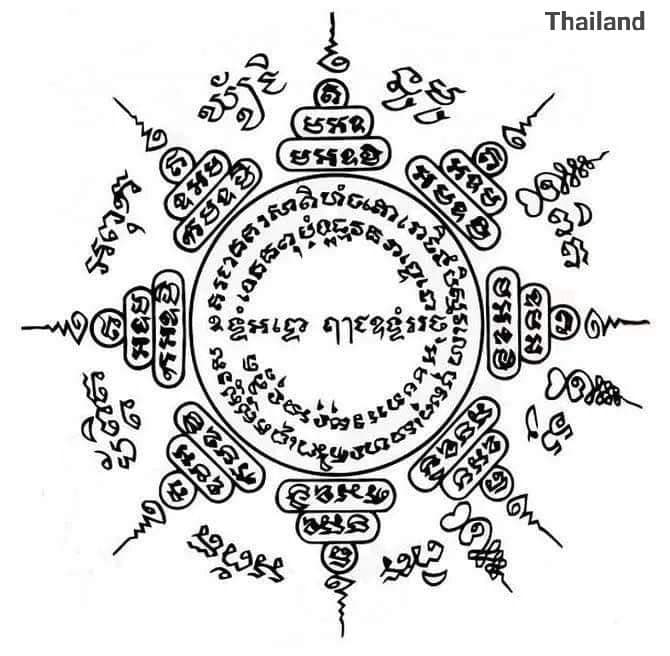
3. Paed Tidt: eight directions
Protection in all eight directions. The yant for travellers and people who are often on the move. More about the Paed Tidt.
The design is built up in a circle or a square, with eight sections that each protect one direction. It works well between the shoulder blades or on the upper back. There is also a more compact variant, the Paed Tidt with letter field. Travellers often combine it with a Hah Taew.
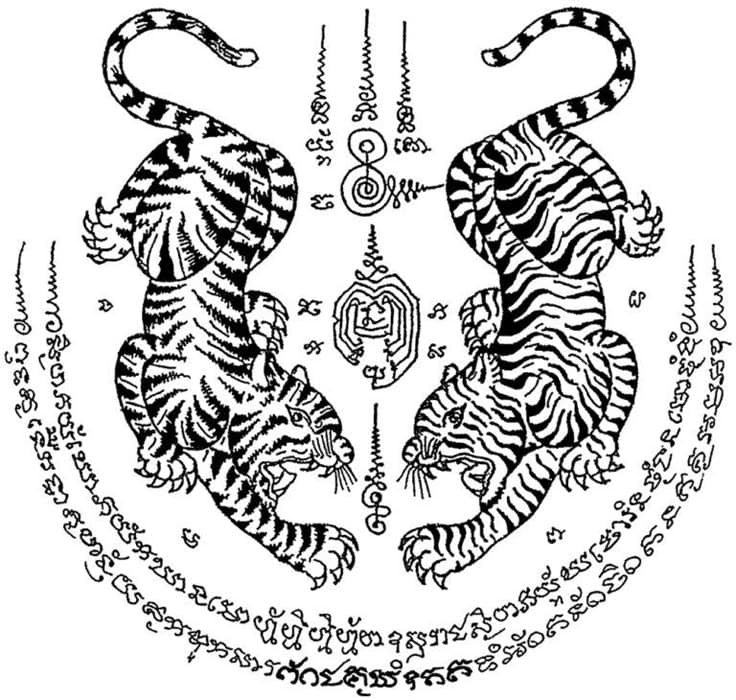
4. Suea Koo: twin tigers
Two tigers for strength, courage and authority. Popular with martial artists, soldiers and business owners. A wide design for the upper back. The Suea Koo explained.
There are several versions: in a circle, with a mantra arch, with a temple yantra or with text panels. The upper back is the classic spot, because the design is wide. Tattooing a Suea Koo too small is a common mistake, as the stripes and the script need room.
5. Suea: the tiger
The single tiger stands for raw strength and fearlessness. There are many variants, from a tiger's head to a leaping tiger. More about the tiger.
The tiger head puts the emphasis on authority, the leaping tiger on breaking through and the full-body tiger on patience and focus. Tiger yants suit the upper back, the shoulder or the upper arm, depending on the shape. With vertical designs, such as the leaping tiger, the side of the back works too.
6. Hanuman: the monkey god
Hanuman from the Ramayana stands for strength combined with loyalty. The yant for people who stand up for others. Who Hanuman is.
Hanuman appears in many poses: seated, leaping with a flag, on a Singha or together with a Naga. Each pose puts a slightly different emphasis, from calm strength to active protection. Most Hanuman designs are vertical and work well on the shoulder, the upper arm or the side of the back.
7. Na Metta: loving kindness
Dedicated to metta: warmth, charisma and good connections with others. Traditionally placed close to the heart. See the Na Metta.
Metta is one of the four sublime states in Buddhism: the wish for others to be well. The yant is often chosen by people who work with people or who want more warmth in their relationships. The design is compact and fits on the chest, the ribs or the shoulder blade. Keep in mind that the ribs are among the more sensitive spots.
8. Unalome: the path of life
A line that runs from a spiral to a straight line: from searching to clarity. Its slim shape suits the neck or a spot along the spine. The unalome explained.
The unalome comes in many variants: minimal, geometric or as part of a larger yant. Mind the direction: the spiral belongs at the bottom and the straight line points upwards, otherwise the meaning is reversed. Because of its small size, it is a popular first yant.
9. Lotus: blooming out of the mud
The lotus grows out of mud and blooms clean above the water. It is often chosen after a difficult period. There are several variants, including one with the five lines of the Hah Taew. All about the lotus.
There are lotus designs with hong birds, with vertical mantra or entirely in red. The lotus is often placed on the upper back or the shoulder, with the flower opening upwards. People often choose it after a loss or a difficult period, as a sign that something new can grow.
10. Ganesha: the remover of obstacles
Known in Thailand as Phra Pikanet, the protector of new beginnings. Chosen by people starting a business or beginning something new. More about Ganesha.
Ganesha is originally a Hindu god, but has been part of Buddhist practice in Thailand for centuries. Artists, musicians and entrepreneurs revere him as the protector of the arts and of new beginnings. There is also a double Ganesha. The design is usually vertical and works well on the shoulder or the upper back.
Combinations that come up often
Many people do not stop at one yant. A few combinations that come up again and again: a Gao Yord as the foundation with a Hah Taew beside it, a Paed Tidt with a Hah Taew for people who travel a lot, and a Suea Koo below a Gao Yord on the back. People who want to combine love and protection sometimes choose a Na Metta close to the heart and a Hah Taew on the shoulder blade.
Plan combinations in advance, so that the yants form a whole and the order is right. Traditionally, the most sacred yant goes highest.
What popular does not tell you
The fact that a design is chosen often says something about what many people are looking for: protection, strength and luck. It says nothing about what suits you best. There are dozens of lesser-known yants, such as the Maha Amnaj for authority, the Kroh Petch as a shield and the turtle for a long life, that are a much better fit for some people.
If you are unsure, start with the question of what the yant should do for you, and only then look at how often it is chosen.
How do you choose between these ten?
Start with what you are looking for, not with the picture. Protection leads to the Hah Taew, Gao Yord or Paed Tidt. Strength to the tigers or Hanuman. Love and connection to the Na Metta. Calm and direction to the unalome or the lotus. The full guide by intention.
Then look at placement and size. A narrow design like the Hah Taew or an unalome fits smaller spots, while a Suea Koo needs an upper back. How to choose the spot.
Frequently asked questions about popular Sak Yant designs (FAQ)
What is the best-known Sak Yant?
The Hah Taew, with five vertical lines of mantra. The yant became famous worldwide because Angelina Jolie has one.
Which Sak Yant is best as a first one?
Many people start with the Gao Yord or the Hah Taew, because protection almost always fits. If you already know exactly what you are looking for, start there.
Are there more designs than these ten?
Yes, many more. In the overview of all designs you will find dozens of yants with their meaning.
Can I combine several popular designs?
Yes, that happens a lot. Discuss the order and the placement beforehand, so that the whole fits together.
Is a popular yant less personal?
No. The meaning is the same for everyone, but the size, the placement and the intention with which you get it make it personal. No two Hah Taews are ever exactly the same.
Which Sak Yant can be the smallest?
Narrow designs such as the unalome and the Hah Taew can go smallest. Animals and designs with a lot of detail need more room to stay legible.
Recent blogs
Dive deeper into Sak Yant, traditions and tattoo care.
Getting a Sak Yant from Amsterdam, Rotterdam, Utrecht or Eindhoven
You will not find an authentic Sak Yant in every city. How long it takes to reach the studio in Breda from Amsterdam, Rotterdam, The Hague, Utrecht and Eindhoven, and what to look for.
5 min read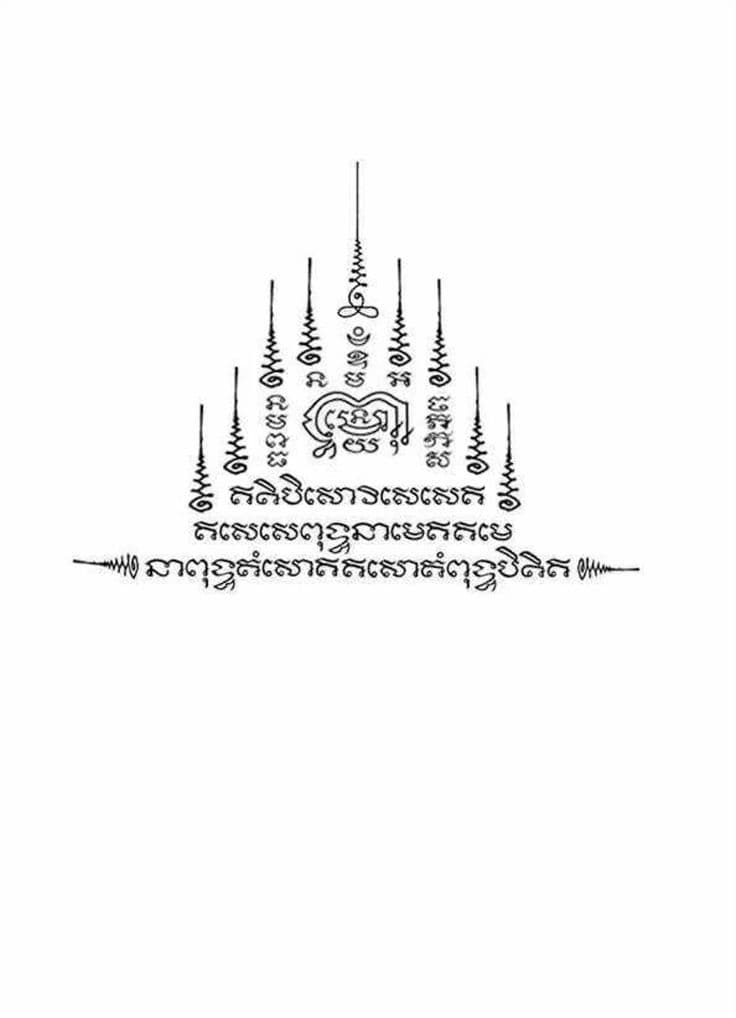
12 myths about Sak Yant (and what is really true)
Only monks, only in Thailand, only for men? Twelve myths about Sak Yant that you hear a lot, and what the reality is.
7 min read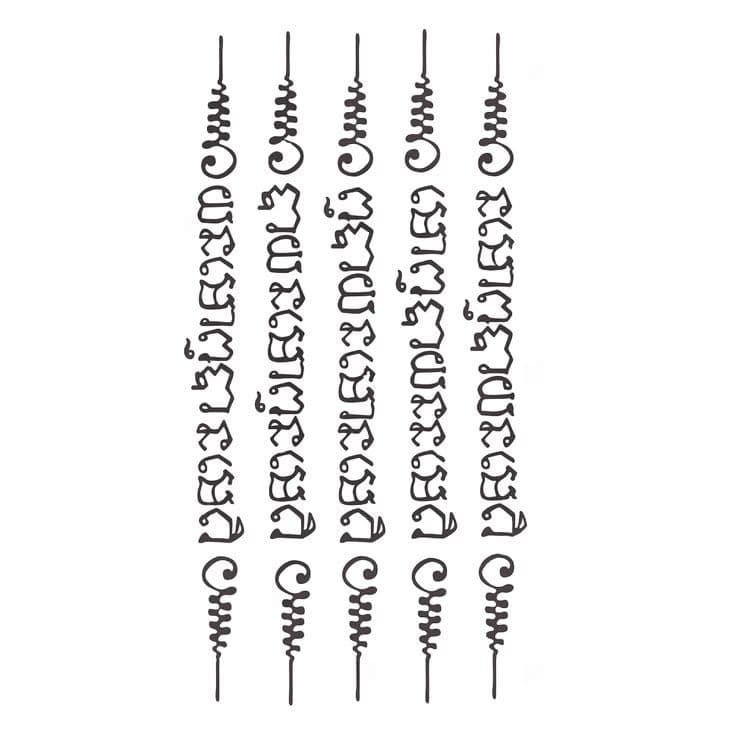
What happens in a Sak Yant session? From first message to aftercare
What happens when you get a Sak Yant? The whole process in six steps: first contact, the intake conversation, preparing, the session, the blessing and aftercare.
6 min read