
Suea Koo meaning: the Sak Yant with two tigers
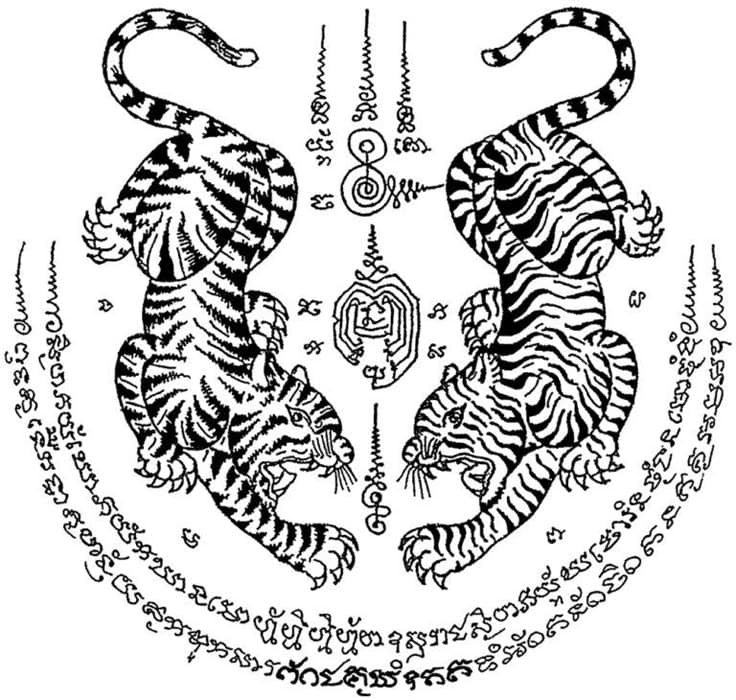
The Suea Koo shows two tigers and stands for strength, courage and authority. Why there are two, which variants exist, and where the design works best on your body.
The Suea Koo is the Sak Yant with the two tigers. Koo means pair or twin, Suea means tiger. After the Hah Taew, it is one of the designs you see most often on the backs of Thai fighters, soldiers and business owners. That is no coincidence: it is a yant for people who need strength when it really counts.
This article explains what the two tigers mean, why there are two rather than one, which variants exist and where the design works best on your body. If you would like to know more about the single tiger first, read our explanation of the Suea.
What does Suea Koo mean?
In many Asian cultures the tiger is seen as the noblest animal there is. It commands respect, stays alert, shows courage and answers to no one. A tiger yant passes those qualities on to the person who wears it. This is not only about physical strength, but just as much about mental resilience: the ability to overcome fear and stay on your feet under pressure.
Two tigers together stand for a greater power, just as two animals are stronger than one in nature. That is why the Suea Koo is seen as an amplified version of the tiger: more authority, more protection, more presence. In Thailand the yant is often worn by people in high-risk professions, such as Muay Thai fighters, soldiers and police officers, but also by business people and politicians looking for inner strength in their work.
Why two tigers?
The two tigers are not simply repeated for the sake of symmetry. They are read as two sides of the same strength. One tiger stands for strength you use, the other for strength you hold back. Attack and defence, daring and self-control. A tiger that only attacks is dangerous, to itself as well. The pair shows that real strength needs both.
In designs where the tigers face away from each other, this is also read as protection in two directions: from the front and from behind. When they face each other, the emphasis shifts to the balance between the two and to what stands between them, usually a block of sacred script.
The variants of the Suea Koo
There is no single Suea Koo. Every master gives the design his own execution, and over time a number of fixed variants have developed. This site features five of them.
The classic Suea Koo shows two mirrored tigers above a block of Khom script. This is the version most people have in mind.
In the Suea Koo in a circle, the script closes around the whole design. In the yantra tradition a closed ring is read as protection without an opening: there is no side through which anything can get in.
The Suea Koo with mantra arch is wider and lower, with three open arches of script beneath the tigers. Because the arches do not close, the design naturally follows the line of the shoulders.
In the Suea Koo with temple yantra, the tigers stand around a yantra grid with temple spires. The protection of the script literally sits between the two animals.
The Suea Koo with Khmer panels places the tigers in a frame of text panels, above, below and on either side. That layout shows clearly how image and text belong together in a Sak Yant.
The script is the actual yant
The tigers catch the eye, but in the tradition the script is the part that does the work. The lines in Khom script contain a kata, a protective formula that is recited while the yant is being tattooed. Without the right text, a Suea Koo is a drawing of two tigers. That is also why copying a design from the internet is risky: if you cannot read the script, you do not know what it says. More about the script in a Sak Yant.
Where do you place a Suea Koo?
The Suea Koo is a wide design, and that largely determines its placement. The classic spot is the upper back, between or across the shoulder blades. There the design has room and sits high on the body, which the tradition considers respectful. The upper arm and shoulder are also possible, especially for the narrower variants. How to choose the right spot for your yant.
A tiger yant is never placed below the waist. In Thailand the feet and lower legs are considered the lowest part of the body, and a sacred design does not belong there.
Size matters too. The tigers have fine detail in the stripes and claws, and the script beneath them has to stay legible. Tattooing a Suea Koo too small is the most common mistake: after a few years the lines start to blur together.
Suea Koo and Khong Khuen
If you have seen videos of the Wai Khru festival at Wat Bang Phra, you will have seen people charging forward in a trance. This is called Khong Khuen: according to the tradition, the wearer is temporarily taken over by the spirit of their yant. It happens strikingly often to wearers of a tiger yant, who then move like a tiger, growling, their hands curled like claws. It shows how seriously the animal is taken in the tradition.
The Suea Koo alongside other tiger yants
The Suea Koo is not the only yant with a tiger. The tradition has a whole family of them, and the choice between those variants says something about which side of the tiger you are looking for.
The Suea Phen shows a tiger mid-leap: strength in motion, aimed at breaking through. The tiger head puts the emphasis on the gaze and the open jaws and works above all as fearsome authority. The full-body tiger shows the animal on the prowl, focused and patient. And in the tiger with red Khom script, the mantra stands out in red ink.
Where the single tigers are mainly about a direction of strength, the Suea Koo is about balance. If you are unsure, ask yourself whether you are looking for strength to break through something or strength to stand firm. The first points more towards a leaping tiger, the second towards the Suea Koo.
Combining with other yants
Many wearers do not have the Suea Koo as their only yant. A common layout is a Gao Yord on the neck or between the shoulders, with the Suea Koo below it on the back. The Gao Yord is then seen as the foundation, and the tigers as the strength that builds on it. The Hah Taew is often added as well, usually on a shoulder blade beside or above the tigers.
Plan the whole thing in advance. A Suea Koo takes up a lot of space, and if you want to add something later, choose the spot so that there is room left. You look at this together in the consultation before the session.
How to recognise a well-tattooed Suea Koo
Look at healed work, not fresh photos, and check three things. The script is even and legible, down to the smallest syllables. The two tigers mirror each other without looking stiff. And a year on, the lines are as sharp as when they were tattooed. Hand poke lines are often slightly softer than machine work, but they should not blur.
Who is the Suea Koo for?
The yant suits people looking for strength in the sense of steadfastness: in a demanding job, in a sport, or in a period of life that asks a lot of you. It is less suitable if you are mainly looking for calm or connection. In that case a lotus or a Na Metta is the more obvious choice. If you are torn between a single and a double tiger, the question is mostly how much space you have and how much emphasis you want to put on authority.
As with every yant, the Suea Koo comes with five life rules. According to the tradition, a tiger yant gives strength, but it also asks you not to misuse that strength.
Frequently asked questions about the Suea Koo (FAQ)
What is the difference between Suea and Suea Koo?
Suea is the single tiger, Suea Koo is two. The meanings are closely related: strength, courage and authority. The pair also stands for a greater, balanced power and is often seen as the stronger variant.
Is a Suea Koo only for fighters?
No. The yant is popular with fighters and soldiers, but in Thailand business owners, politicians and people in demanding jobs wear it too. It is about inner strength, not about fighting.
Can a woman get a Suea Koo?
Yes. In the tradition the tiger has no gender. It is a large design, though, so the placement deserves some thought. More about Sak Yant for women.
How big does a Suea Koo need to be?
Big enough to keep the stripes and the script legible ten years from now. On the upper back that is rarely a problem. On an upper arm, the narrower variant with the mantra arch is often the better choice.
How long does it take to tattoo a Suea Koo?
That depends on the size and the variant. A Suea Koo is one of the larger designs, so it takes longer than a Hah Taew or a unalome. You will get an estimate during the consultation beforehand. What a Sak Yant costs.
Can I combine a Suea Koo with a Hah Taew?
Yes, it is a popular combination. The Hah Taew stands for protection and luck, the Suea Koo for strength and authority. Do mind the placement, though: both belong high on the back or the shoulders.
Recent blogs
Dive deeper into Sak Yant, traditions and tattoo care.
The 10 most popular Sak Yant designs and what they mean
From the Hah Taew to Ganesha: the ten Sak Yant designs chosen most often, with their meaning and where they work best on the body.
6 min read
Getting a Sak Yant from Amsterdam, Rotterdam, Utrecht or Eindhoven
You will not find an authentic Sak Yant in every city. How long it takes to reach the studio in Breda from Amsterdam, Rotterdam, The Hague, Utrecht and Eindhoven, and what to look for.
5 min read
12 myths about Sak Yant (and what is really true)
Only monks, only in Thailand, only for men? Twelve myths about Sak Yant that you hear a lot, and what the reality is.
7 min read