
The script inside a Sak Yant: which language is really written in your sacred tattoo?
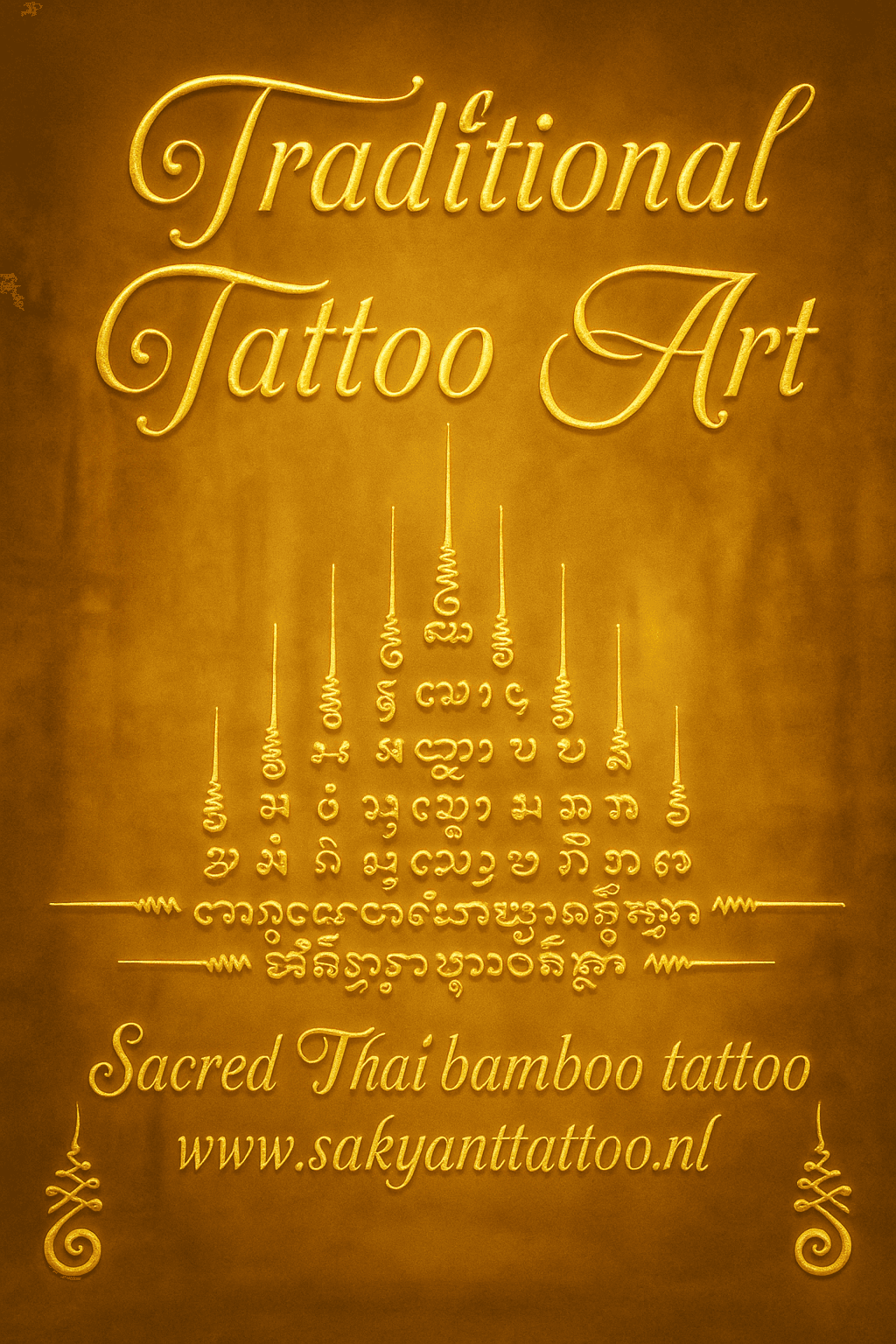
Among the animals and spirals of a Sak Yant sit small, elegant characters almost no one can read. Yet those carry the heart of it. Discover which script it is (Khom), which language it comes from (Pali), what the letters (kata) mean and why you should never let them be copied off the internet.
The letters almost no one can simply read
Look closely at a Sak Yant and, among the animals, spirals and geometric shapes, you will see small, elegant characters. To most people, and even to many Thais, they are unreadable. Yet those very marks carry the heart of the tattoo: they are not decoration, but sacred text.
A Sak Yant without text is like a prayer without words: the form is there, the meaning is not.
In this article you will learn which script sits inside a Sak Yant, which language it comes from, what those letters mean and why you should never let them be copied straight from the internet.
Which script is written in a Sak Yant?
The script is called Khom, in full the Khom script (in Thai: aksorn khom). It is an ancient writing system derived from the Khmer script of the old Cambodian empire. For centuries, Buddhist monks and masters in Thailand, Cambodia and Laos used it to record sacred texts.
Important: Khom is not the same as the modern Thai alphabet. It is far older and was kept for religious and magical texts. As a result, the average Thai person today can no more read it than you can. It is truly a script for the initiated.
Khmer and Pali texts as the source
The forms and texts that appear in a Sak Yant are recorded in old Khmer and Pali manuscripts. Pali is the classical language of Theravada Buddhism, the language in which the oldest teachings of the Buddha were handed down. The Khom script was used to write those very Pali words. A Sak Yant is therefore a bridge between two worlds: the script is Khmer in origin, the language within it is usually Pali.
What do the letters mean? The kata
The short lines of text in a yant are called kata (from the Pali word gatha): sacred verses or spells. While the master places the tattoo, he recites these kata in silence. The text and the intention are literally brought into the skin.
Many yants contain compressed mantras, where an entire spell is reduced to separate syllables or even a single letter. A well known example is Na Mo Put Ta Ya, the five syllables that stand for the five Buddhas. In the tradition, a single Na can already represent a complete protective spell.
Text and symbols work together: the animals and geometric shapes give the yant its character, the kata gives it its voice.
Spirals, dots and the unalome
Above or around many yants you will see a spiral that runs out into a straight line with dots: the unalome. It stands for the path to enlightenment, the winding road of life that finally becomes straight and clear. The dots and small circles at the top of a yant are often shortened syllables or sacred numbers, not random decoration.
Where the forms come from
According to tradition, the basic forms of the yants were set down centuries ago by monks and scholars, based on the old Khmer and Pali texts. In addition, various masters have added new forms over time, after seeing them during deep meditation. In this way a living tradition took shape: a fixed core of classic yants, extended with forms passed from master to student.
Why you should never simply copy the script
Because almost no one can read Khom, things often go wrong. A design copied blindly from the internet or Pinterest regularly contains letters that are mirrored, misspelled or simply meaningless. What was meant as protection then becomes a string of dead marks.
Worse still: sometimes it accidentally says something disrespectful or incoherent. In a tradition where the text carries the power, that is no small detail. This is why a real Ajarn writes the kata himself, by hand, while reciting the spell.
The difference between a real Sak Yant and a copy is not in the lines, but in the letters.
How to recognise authentic Khom script
You do not need to be an expert to see the difference. Watch for these three things:
The letters consistently face the same way. Mirrored or toppled characters give away blind tracing.
The master can explain what it says. A real Ajarn tells you which kata he is placing and what it protects or strengthens.
The text belongs to the design. Every classic yant has its own kata; random letters beside a known symbol are wrong.
Frequently asked questions about the script in a Sak Yant (FAQ)
Which language is a Sak Yant written in?
Usually in Pali, the classical language of Theravada Buddhism, written in the ancient Khom script derived from Khmer. Sometimes individual Sanskrit words appear as well.
Can Thai people read the script?
Usually not. Khom is not modern Thai, but an ancient script mastered mainly by monks and Sak Yant masters. The average Thai can read it no better than a westerner.
What is a kata?
A kata is a sacred verse or spell. In a Sak Yant it is the text the master recites while placing it; it gives the yant its meaning and, according to tradition, its power.
Can I choose my own text for my Sak Yant?
The kata belongs to the design and its purpose. You can discuss your wish, think of protection, luck or strength, and the master chooses the correct, fitting kata for it. Translating loose words into Khom is not how the tradition works.
Is a Sak Yant with text the same as a tattoo with Thai letters?
No. A tattoo with modern Thai script is simply readable language. A Sak Yant uses the sacred Khom script with kata, placed with intention and blessing. It is sacred art, not a line of text.
Have your Sak Yant written, not traced
The script is the heart of a Sak Yant. It decides whether you carry a living, meaningful mark or a pretty copy without a voice. With us, every kata is written by hand by a blessed master, matched to the design and to your intention.
Want to know which yant and which kata suit you? Book a free introductory talk and we will calmly explain everything.
Recent blogs
Dive deeper into Sak Yant, traditions and tattoo care.

Sak Yant video: how a Sak Yant is tattooed in the Netherlands
A Sak Yant from start to finish, filmed at the studio. Watch the video and read what you see: the design, the rod, the calm in the studio and the closing moment.
4 min read
The 10 most popular Sak Yant designs and what they mean
From the Hah Taew to Ganesha: the ten Sak Yant designs chosen most often, with their meaning and where they work best on the body.
6 min read
Getting a Sak Yant from Amsterdam, Rotterdam, Utrecht or Eindhoven
You will not find an authentic Sak Yant in every city. How long it takes to reach the studio in Breda from Amsterdam, Rotterdam, The Hague, Utrecht and Eindhoven, and what to look for.
5 min read