
Lotus tattoo meaning: rising out of the mud
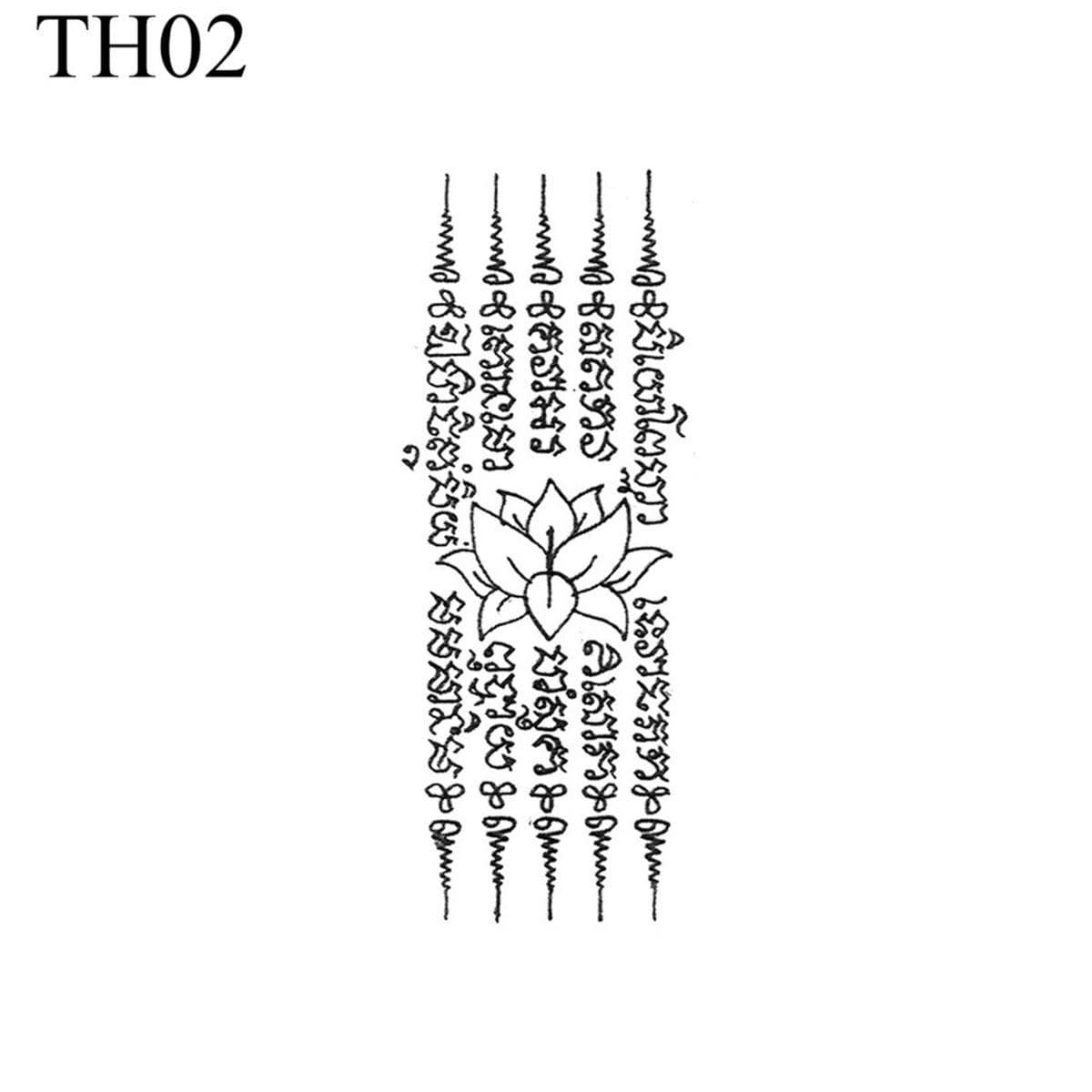
The lotus stands for flourishing that comes out of difficult circumstances. Its origins, the meaning of each colour, the petal count, its role within Sak Yant and the mistakes to avoid.
The lotus is one of the few symbols whose meaning almost everyone knows without ever having been taught it: something beautiful coming up out of something filthy. That is right, but it is the short version. In the traditions the flower comes from there is far more to it, down to the colour and the number of petals.
Below is the full explanation: where the lotus comes from, what the three layers of the symbol mean, what the colours say, how it is used within Sak Yant, and which mistakes are worth avoiding when you design one.
Where the lotus comes from
The lotus is central to both Hinduism and Buddhism. In Southeast Asia it is everywhere: in temples, on offering trays, in sculpture. Buddha is almost always depicted seated on a lotus throne, and in Thailand the closed bud is brought as an offering when people pray.
That is not decoration. The plant roots in muddy ground, comes up through cloudy water and opens above the surface without a trace of mud on its petals. Precisely that property makes it a symbol: it shows that the conditions something starts in do not determine how it ends.
There is a second natural property on top of that. The flower closes at night and opens again with the light. In many texts that is read as beginning again each day, and as the difference between not seeing and seeing.
The meaning: mud, water, bloom
The lotus is read in three layers, from bottom to top. The mud stands for the circumstances you did not choose. The water for the phase where you are in the middle of it and cannot see anything yet. The bloom for the moment you come out above it.
The core of the symbol sits in that last part: the flower is not beautiful despite the mud, but because of it. Without that soil nothing grows. Which is also why the lotus is often chosen after a period of grief, illness or recovery. It does not deny the heavy part, it puts it at the start of the story.
Some designs show all three layers, with roots, stem and flower. Others show only the open bloom. The first tells the process, the second the result. Anyone who values the road there more than the outcome deliberately picks the whole plant.
The lotus across traditions
Buddhism
Here the lotus stands for purification of the mind and for the path to insight. Buddha on a lotus throne indicates that he stands in the world without being soiled by it. In the Thai temple context that Sak Yant comes from, this is the dominant reading.
Hinduism
The lotus, padma in Sanskrit, belongs to several deities. Lakshmi is depicted on a lotus and stands for prosperity, Brahma emerges from one in the creation stories. The emphasis here is more on birth, abundance and beauty than on purification.
Ancient Egypt
The blue water lily, often called a lotus, closed at night and opened in the morning. That is why it was linked to the sun, rebirth and the afterlife. Botanically it is a different plant from the Asian lotus, which immediately explains why the two get confused so often.
Meaning by colour
Colours carry their own layer in Buddhist imagery. The explanation differs by tradition and by source, so read this as the most common reading rather than a fixed rule.
White stands for purity of mind and is most often linked to awareness and meditation. Pink counts in many sources as the highest lotus and is associated with the Buddha himself. Blue is read as wisdom and self mastery, knowledge above sensory desire. Red stands for the heart: love, compassion, involvement. Purple appears less often and is connected to mysticism and the spiritual path.
In black work, which is how most yants are done, that colour layer falls away. The meaning is then carried by the shape, the petal count and by whatever surrounds it. For many people that is preferable: no colour choice that feels different ten years on.
The number of petals
The petal count is read too. Eight is the best known: it is linked to the eightfold path, the eight guidelines that lead to liberation within Buddhism. A lotus with a thousand petals refers to the crown chakra, the highest point in chakra teaching.
Important: this is a layer of reading, not a rule. Many traditional designs simply have the number of petals the shape requires. If you want the number to mean something, say so beforehand, because adding petals later cannot be done without breaking the balance of the design.
The lotus within Sak Yant
Within the Sak Yant tradition the lotus rarely stands alone. It usually forms the base or the frame that holds the mantra text. That fits its role: it carries, it is not the subject. See the Sak Yant designs for the versions it appears in.
The Lotus with five mantra lines combines the flower with five lines of sacred text, in the same structure you know from the Hah Taew. This is the most requested lotus version.
The Lotus with vertical mantra sets the text upright above the flower, which makes the design narrower. Works well on a forearm or along the spine.
The Lotus Hong combines the flower with the hong bird, a design associated with love and connection rather than protection.
What all three share: the text is part of the design and not an ornament around it. Which language that is.
Combinations with other symbols
The lotus with a unalome is the most requested combination: the line of the life path growing up out of the flower. Do make sure the unalome still points upward, because upside down it reverses the meaning. See the unalome design.
Lotus with a mandala behind it is common too: the flower in the centre, the circle around it as an ordered whole. Handsome design, but two traditions that do not need each other. The difference between mandala and yantra.
Lotus with a name, a date or a birth flower is the most personal variant. The rule here: the more text in fine lettering, the sooner the design closes up over time. Better a larger letter and fewer words.
Lotus with a Buddha calls for care over placement. A Buddha image does not belong below the waist, and that outweighs how well the design would sit there.
Styles: how the lotus is applied
Fineline gives a light, drawing like lotus with thin lines. Popular on the forearm and along the spine. Downside: thin lines on fine detail fade sooner, especially on spots that catch a lot of sun.
Blackwork makes the flower more solid, with filled areas. That holds up better across decades and suits larger placements.
Dotwork builds the shading in the petals out of dots. It looks soft and works beautifully for gradients from dark to light, but takes considerably more time.
Handpoke, the traditional method within Sak Yant, gives a slightly softer line than a machine and usually damages the skin less. How handpoke works.
Where to place a lotus
The flower should open upward, so the direction of the design follows the direction of your body. On the back, between the shoulder blades, along the spine and on the forearm that happens naturally. On the side of a leg or on a sloping plane you have to watch that the flower does not half tip over.
Within the tradition, higher on the body counts as more respectful, which makes the back and shoulder the classic spots. More about placement and what it means.
With a small lotus, watch the level of detail. Petals with many fine lines close together will run into each other after about five years. Going slightly larger or reducing the number of lines gives a sharper design in the long run.
Common mistakes
The first: choosing a water lily and thinking it is a lotus. The water lily floats flat on the water, the lotus rises on a firm stem. That rising is what carries the meaning, so the difference is not cosmetic.
The second: too small for the number of lines. A lotus with forty fine petals at four centimetres wide is a dark smudge in ten years. Always ask what the smallest size is at which the design stays readable.
The third: having a design copied from the internet without checking it. With a lotus carrying mantra text that regularly goes wrong, because versions floating around online often contain garbled or unreadable script.
The fourth: choosing colour on taste rather than meaning, and finding out afterwards that the colour says something different within the tradition than you intended. Colour cannot be undone.
Frequently asked questions about the lotus tattoo (FAQ)
Is a lotus tattoo only for women?
No. That image comes from Western tattoo catalogues, not from the tradition. In Thailand the lotus is a religious symbol without gender, and it appears just as readily in large yants on men's backs.
What is the difference between a lotus and a water lily?
Botanically they are different plants. The lotus rises above the water on a firm stem, the water lily floats on the surface. In tattoo designs the two get mixed up constantly, while that rising is exactly what carries the meaning.
Can I choose the colour myself?
You can, although most traditional work is done in black ink. If you want colour, discuss beforehand what meaning you attach to it, because that choice cannot be reversed afterwards.
How many petals should a lotus have?
There is no required number. Eight is chosen most often because of the eightfold path, but many designs simply follow what the shape needs. If you want the number to carry meaning, say so up front.
Can the lotus be combined with a unalome?
Yes, that is one of the most requested combinations: the unalome growing up out of the lotus. Just make sure the unalome still points upward. See the unalome design.
How long does a lotus take?
A single, simple lotus is one of the shorter designs. If it becomes the base of a full yant with mantra lines, that whole piece sets the length of the session. Handpoke takes longer than machine work for the same design.
What does a lotus tattoo cost?
That depends on size, level of detail and technique. A fine lotus of a few centimetres sits in a completely different category from a lotus as the base of a back piece. What sets the price.
Is a lotus a good first tattoo?
Often yes. The shape works small and large, it is not tied to a specific spot, and the meaning is personal for most people without becoming too explicit. Do go slightly larger than your first instinct so the detail stays durable.
From flower to design
The lotus is one of the few symbols that works both on its own and inside a larger yant. What fits depends on whether you want the flower as the subject or as the carrier of something else. That is precisely the question that comes up first in the intake, before anything is drawn.
Recent blogs
Dive deeper into Sak Yant, traditions and tattoo care.
Can a Westerner get a Sak Yant? On respect and cultural appropriation
Is a Sak Yant cultural appropriation? How people in Thailand see it, where the line lies between respect and a lack of it, and what you can do in practice.
7 min read
Holistic tattoo: a tattoo as a ritual, not a product
Holistic tattooing means the reason, the conversation, the ritual and the aftercare weigh as much as the design. The four phases, what really differs, and what merely sounds good.
10 min read
Mandala tattoo meaning: and why a yantra is something else
A mandala is an image to rest your attention in, a yantra is a working diagram. The structure, the types, the difference, and where a mandala does and does not work on your body.
11 min read