
Mandala tattoo meaning: and why a yantra is something else
A mandala is an image to rest your attention in, a yantra is a working diagram. The structure, the types, the difference, and where a mandala does and does not work on your body.
Mandala tattoos are everywhere, and that is exactly the problem with their meaning. What began as a meditation aid has also become a decorative pattern that happens to wrap nicely around a shoulder or a knee. Both are allowed, but it is worth knowing which of the two you are getting.
Below: what a mandala is, how it is built, which types exist, how it differs from a yantra, and what it demands technically. That last part is not a side note here. No tattoo form exposes mistakes as ruthlessly as a symmetrical circle.
What is a mandala?
Mandala is Sanskrit for circle. In Hinduism and Buddhism it is a geometric image representing an ordered whole: the universe, a deity, or the mind itself. You do not use it to look at but to let your attention rest in, from the outer edge inward.
The best known example is the sand mandala of Tibetan Buddhism. Monks work on one for days with coloured sand, down to the smallest detail, and then sweep it apart in one movement. That is not an anticlimax but the point of the exercise: everything is temporary, including what you built with the greatest care.
That makes the mandala an interesting choice as a tattoo. You are putting a symbol of impermanence permanently on your skin. Some people find that a contradiction, others consider it the strongest argument for choosing one.
The structure: circle, centre, repetition
Every mandala shares the same principles. There is a centre, where the eye is led. There is symmetry, usually in four, six or eight directions. And there is repetition: the same motif growing larger, or finer, as it moves outward.
Traditionally it is read from the inside out, or the other way round as a meditation: you start at the edge and work toward the centre, with each ring a layer you pass through. In temple versions there are gates in the outer ring, one for each cardinal direction.
That structure is also why a mandala is technically demanding on skin. Symmetry on a curved surface requires the design to be aligned on your body rather than traced flat. A mandala that works on paper and sits crooked on a shoulder is almost impossible to correct afterwards.
Types of mandala
Floral mandala
The best known in tattoo form: rings of petals growing outward, often with a lotus at the centre. Soft in shape, relatively forgiving in placement, and the version most often read as ornamental rather than religious.
Geometric mandala
Clean lines, angles and repeated shapes with no organic elements. Looks more modern and sits well alongside existing blackwork. Downside: every irregularity in a straight line is immediately visible, making this the least forgiving version technically.
Sri Yantra
Nine interlocking triangles around a central point, from the Hindu tradition. Often called a mandala, but strictly speaking a yantra: it belongs to a mantra and a specific function. Anyone choosing it is not choosing decoration.
Half mandala and ornamental work
A mandala cut off halfway and flowing into ornamental work, often on the forearm, chest or hip. Practical on body parts where a full circle would distort, and easier to extend later than a closed circle.
Mandala or yantra: the difference
The terms get used interchangeably, but they are two different things.
A mandala is contemplative. It is meant to let your attention settle, is almost always circular, and has no prescribed effect. The form may vary as long as the structure holds.
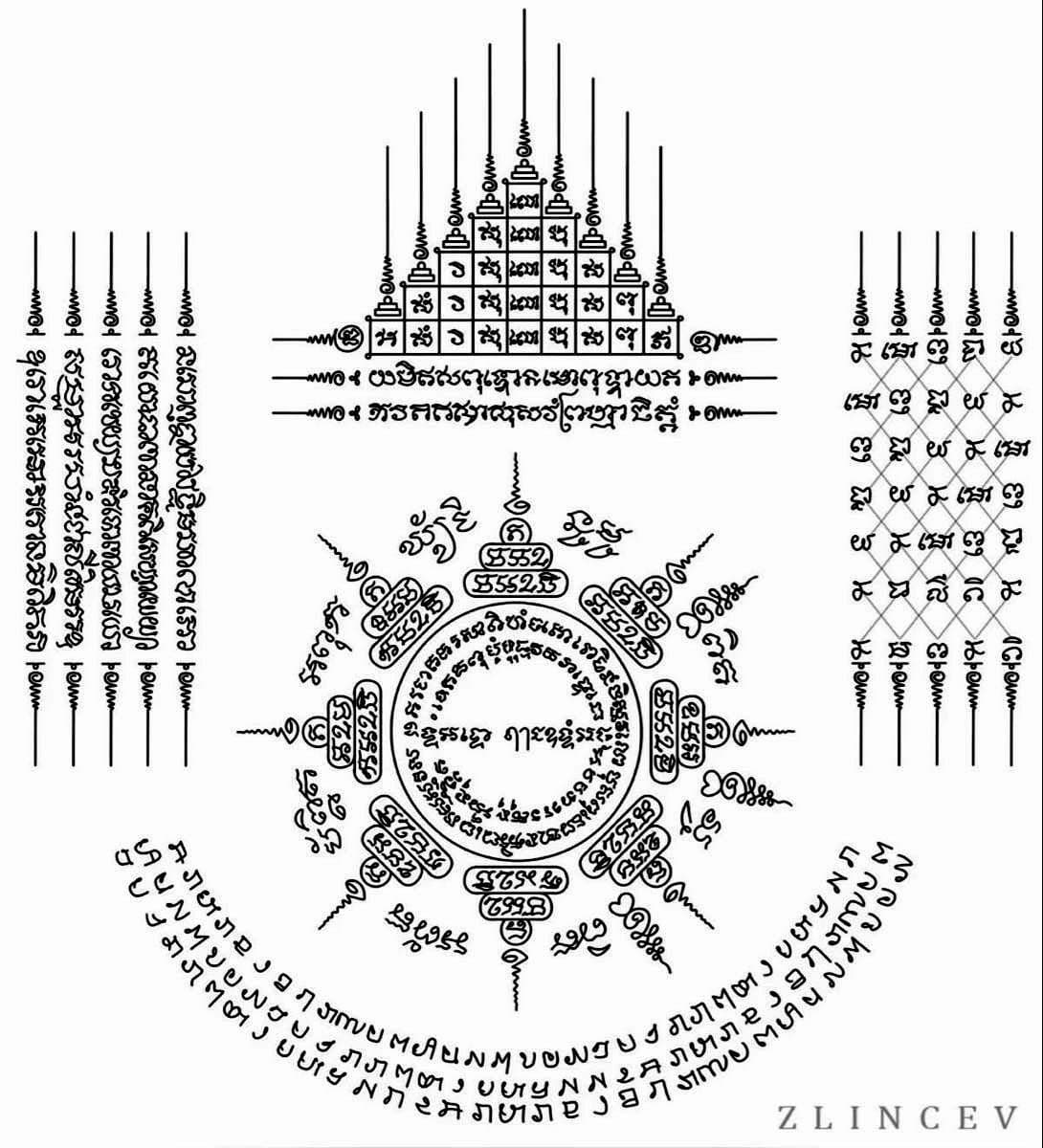
A yantra is functional. It is a diagram belonging to a specific mantra and a specific purpose: protection, prosperity, strength. The form is fixed, often with triangles and squares rather than only circles, and the text inside is part of the whole. The word Yant in Sak Yant comes from exactly there.
Put briefly: a mandala is an image to rest in, a yantra is an instrument with an assignment. Anyone getting a mandala because they want protection is, strictly speaking, choosing the wrong symbol.
The Yantra schema design shows that structure clearly: the geometry, the text panels and the centre form a working whole.
If you want to know what is actually written inside such a diagram, the script is the starting point. About the script in a yant.
What it means to wear one
Apart from the tradition, people usually choose a mandala for three reasons. As an image of balance, because the symmetry is literally in equilibrium. As a reminder of impermanence, in the spirit of the sand mandala. Or as marking a centre: the idea that everything happening moves around something fixed.
That last reading is the strongest if you want to make it personal. What sits in the middle then determines what the rest turns around. That can be a symbol, a floral shape, or deliberately left empty. The last happens more often than you would think, and it is one of the few design choices that literally leaves room.
Technique: dotwork, line work and handpoke
Dotwork is the most used technique for the shaded areas of a mandala. Gradients are built out of dots, giving a soft, almost grey impression. It costs a lot of time, and uneven dot density stands out immediately in a symmetrical design.
Line work carries the structure. In a mandala those lines must be not only straight but also equal in weight, otherwise the circle appears to tilt. This is the part where craftsmanship shows fastest.
Handpoke is possible too, and the result looks softer than machine work. It does take considerably longer, especially across large dotwork areas. How handpoke works.
Large mandalas are regularly split across several sessions. That is not slowness but sense: after a number of hours the skin gets irritated and takes ink less well.
Placement and size
Round and convex body parts work best: shoulder, elbow, knee, chest and the middle of the back. There the circle follows the shape of your body. On a forearm or shin a full circle distorts quickly, and a half mandala or one with an ornamental run off works better.
Size here is not a matter of taste but of durability. Mandalas are built on fine lines sitting close together. Go too small and those lines merge over time, and you lose exactly the detail the design is about. Ask your artist what the smallest size is at which this design is still readable in ten years.
Watch out for folds and joints too. A mandala across an elbow or knee looks different straightened than bent, and the skin there stretches more. That can work beautifully, but it is a deliberate choice and not a detail.
If you go for a yantra instead of a mandala, placement also counts in terms of substance. How to choose the right spot.
Mandala as a cover up
Mandalas are often proposed to cover older work, and for good reason: dense line work and dotwork areas hide a lot of noise. Still, it is not automatically the right choice.
A cover up almost always ends up larger and darker than the original. With a mandala that usually means a substantial size and a lot of filled area, which removes the open, airy look that draws people to it in the first place. Always ask for a drawing over a photograph of the existing tattoo before you agree.
And weigh what the symbol has to do for you. Choosing a mandala because it covers well is a practical reason, not a meaningful one. The two can go together, but be honest about which one decided it.
Common mistakes
Symmetry on the wrong surface. A perfect circle on a strongly curved or sloping part of the body looks crooked as soon as you move. Always have the design aligned on your skin before any needle touches it.
Too small for the amount of detail. With mandalas this is the most common long term regret.
Getting a closed circle while you actually want to build on it. Adding a ring around it later is nearly always visible. Say up front if you suspect this is the start of a bigger piece.
And finally: choosing a mandala because you are looking for protection. For that the yantra is the right form, not the mandala.
Frequently asked questions about the mandala tattoo (FAQ)
Is a mandala tattoo disrespectful?
Not in itself. A mandala is not a closed religious object and is used widely. There is a noticeable difference, though, between someone who knows where the form comes from and someone who just picked a pattern. Knowing what you wear is the least you can do.
What does a mandala with a lotus in it mean?
That is a common combination: the ordered circle as a whole, with the lotus as the image of flourishing at the centre. More about the lotus and its meaning.
How long does a mandala tattoo take?
Considerably longer than the size suggests, because every line has to be exact and dotwork takes time. A large mandala is regularly split across several sessions, certainly with handpoke.
What does a mandala tattoo cost?
The price follows the time, and with this design that is higher than the size suggests. Level of detail and technique weigh more than the number of centimetres. What sets the price.
Can a mandala be done with handpoke?
Yes, and the result looks softer than machine work. It does take longer and asks more patience from both sides. How handpoke works.
Can I extend a mandala later?
Only if the first design accounted for it. A mandala is a closed whole: adding a ring around it later almost always shows. So say up front if you suspect you want to build on it.
Where does a mandala hurt least?
On fleshy areas further from bone: shoulder, upper arm, thigh and the side of the back. Elbow, knee, ribs and the centre of the chest are considerably more sensitive. More about pain by placement.
Is a mandala suitable as a first tattoo?
Only if you are willing to go for a size that carries the detail and to sit for several hours. A small, quick mandala as an introduction is precisely the version that disappoints most after a few years.
Circle or diagram?
The choice between a mandala and a yantra is ultimately the choice between an image and an assignment. If you want something to rest in, the mandala is the right form. If you want a symbol with a specific meaning and a tradition behind it, look at the yants.
And if you are not sure, that is exactly what the conversation before the design is for. A good design answers a question you got clear on first.
Recent blogs
Dive deeper into Sak Yant, traditions and tattoo care.
Can a Westerner get a Sak Yant? On respect and cultural appropriation
Is a Sak Yant cultural appropriation? How people in Thailand see it, where the line lies between respect and a lack of it, and what you can do in practice.
7 min read
Holistic tattoo: a tattoo as a ritual, not a product
Holistic tattooing means the reason, the conversation, the ritual and the aftercare weigh as much as the design. The four phases, what really differs, and what merely sounds good.
10 min read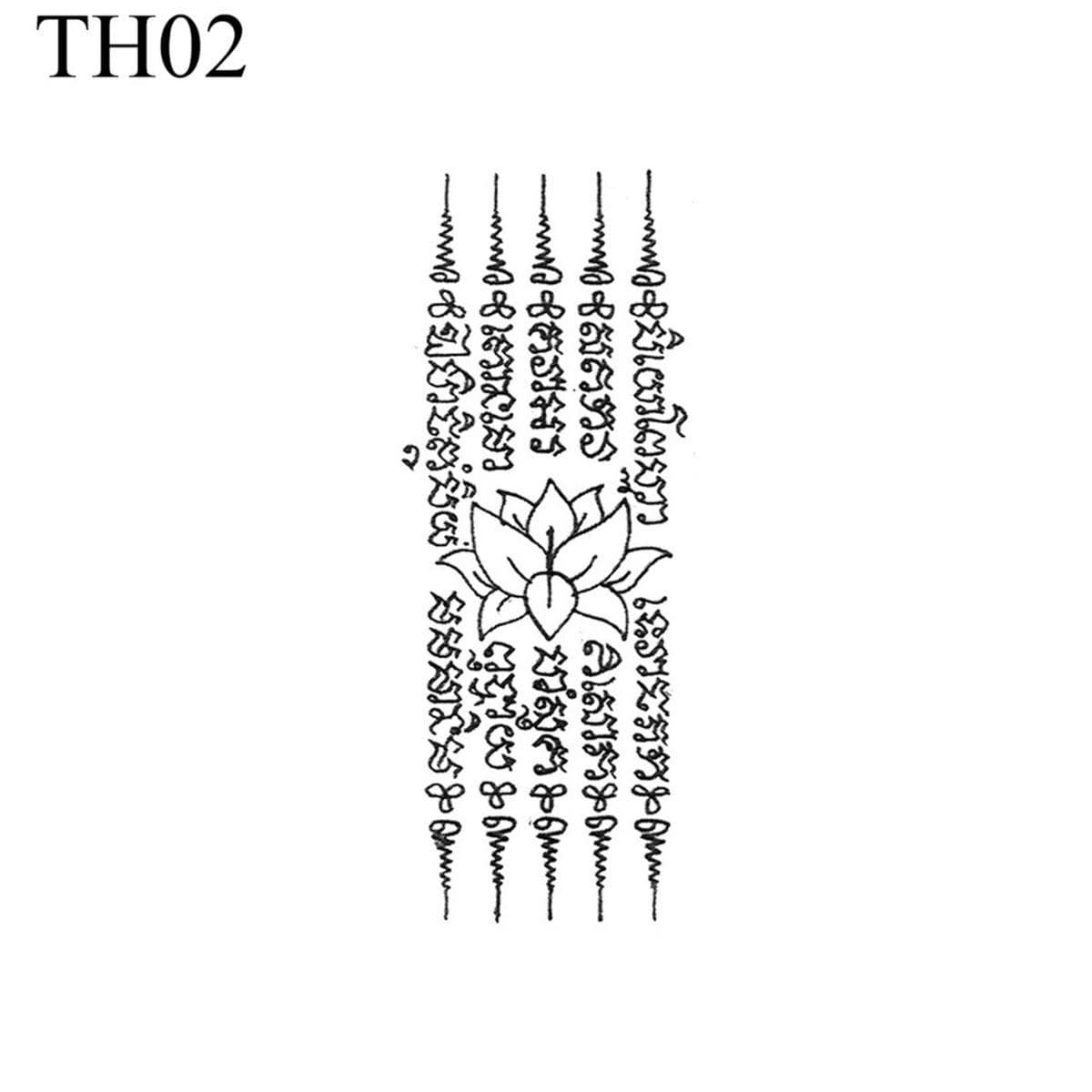
Lotus tattoo meaning: rising out of the mud
The lotus stands for flourishing that comes out of difficult circumstances. Its origins, the meaning of each colour, the petal count, its role within Sak Yant and the mistakes to avoid.
11 min read