
Why our prices end in 9
Our prices always end in a 9. Not a coincidence and not a sales trick, but a reference to a number that has its own meaning in the Thai tradition.
It stands out as soon as you look at our rates: everything ends in a 9. People notice it regularly, and usually with the same assumption behind it, namely that it is a sales trick. It is not. There is a reason behind it that has to do with the tradition itself.
The number nine in Thailand
Nine counts as a lucky number in Thailand. That comes from the language: the Thai word for nine, เก้า (kao), sounds almost identical to ก้าว (kao), which means to move forward or to take a step. Choosing nine is therefore symbolically choosing forward movement. You see it back in house numbers, phone numbers, licence plates and wedding dates.
What that has to do with our prices
The choice to let rates end in a 9 is a nod to that number. It is a small detail, and it changes nothing about what you pay, but it fits how the tradition is handled in the studio: not as decoration, but as something that carries through into the small things.
What it explicitly is not: a way to make an amount look lower than it is. The difference between 249 and 250 is one euro and everybody knows that. Which is why it is simply explained here instead of us hoping nobody asks.
So what does determine the price?
More important than the last digit is where the amount comes from. Three things determine that.
The size and the placement. A design on the forearm takes less time than the same design across the whole back, and curved or sensitive spots work more slowly.
The technique. Traditional hand-poke work with the rod goes slower than machine work. That is a deliberate choice and not an inefficiency: the way a Yant is placed belongs to what it is.
The amount of detail. Figurative designs such as Hanuman or a tiger ask for more time than line and text work, because the expression sits in the detail.
Frequently asked questions about prices (FAQ)
Will I be told the cost beforehand?
Yes. During the intake the design, size and placement are gone through and an estimate follows from that. You will not be facing a surprise once you are in the chair.
Is a more expensive Yant more powerful?
No. The price says something about time, size and detail, not about how it works. Within the tradition, a small design that matches your intention is worth no less than a large one.
Why is there no price list on the site?
Because almost no two sessions are the same. A list would either come out too low and have to be adjusted afterwards, or be so broad that it tells you nothing. An estimate beforehand is more honest.
Recent blogs
Dive deeper into Sak Yant, traditions and tattoo care.
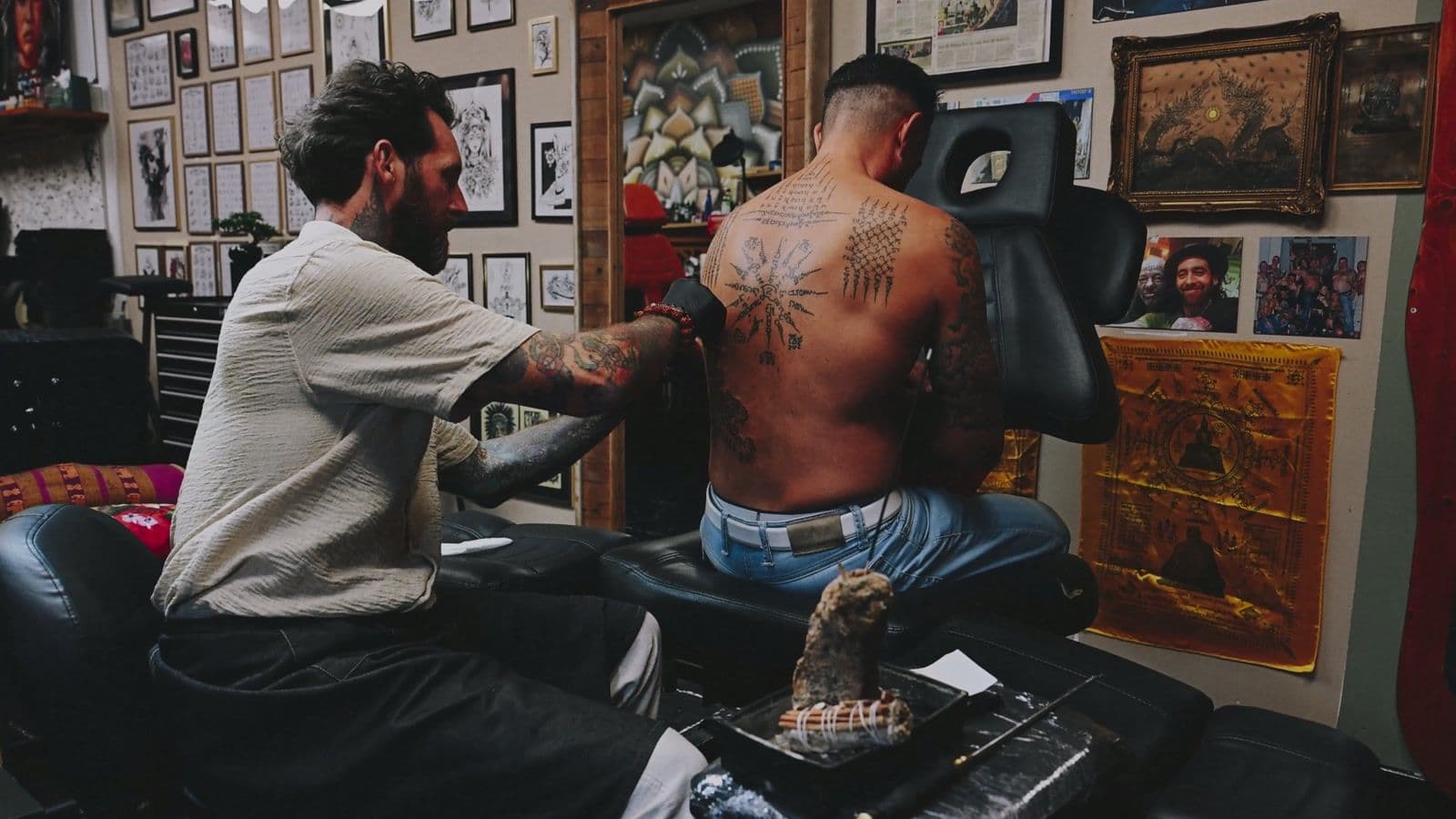
Sak Yant video: how a Sak Yant is tattooed in the Netherlands
A Sak Yant from start to finish, filmed at the studio. Watch the video and read what you see: the design, the rod, the calm in the studio and the closing moment.
4 min read
Tattoos that mean love: six symbols of love and connection
Which tattoo stands for love? Six symbols explained, from the Na Metta and the Hong birds to the lotus, plus strength and love in one design and tattoos for couples.
7 min read
The 10 most popular Sak Yant designs and what they mean
From the Hah Taew to Ganesha: the ten Sak Yant designs chosen most often, with their meaning and where they work best on the body.
6 min read